
Education costs can rise significantly over a 10-year period because of inflation. Starting your child’s financial planning early can give you more time to build the required corpus through appropriate insurance, savings and investment strategies.
Every parent wants to give their child the best possible education. But one question is often overlooked:
“How much will that education actually cost when my child is ready for it?”
A course that costs ₹10 lakh today may not cost the same 10 years from now. Rising education expenses, changing lifestyle costs and inflation can significantly increase the amount a family needs to arrange in the future.
That is why child future planning should begin with a future-cost estimate—not simply today’s education cost.
At PAISA GAIN, our approach is simple: understand the goal today, estimate the future requirement, and create a disciplined financial strategy to work toward it.
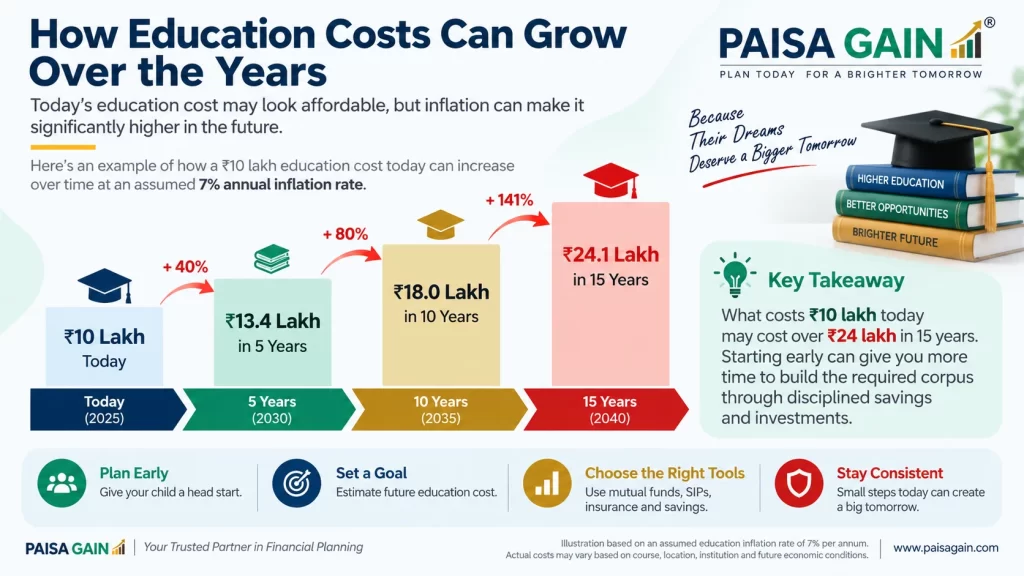
Why Today’s Education Cost Is Not Enough
Suppose your child’s higher education currently costs ₹10 lakh.
If education costs increase by an average of 7% per year, the approximate cost could become:

These figures are illustrations, not predictions. Actual education-cost inflation can be higher or lower depending on the course, institution, location and other factors.
The important lesson is this:
Your child’s future education goal should be calculated using the expected future cost, not today’s price.
The Real Challenge: Planning for a Future Number
Many families say:
“I will start saving when my child gets older.”
The problem is that waiting reduces the time available to build the required fund.
For example, if your target is ₹25 lakh and you have 10 years, you have a meaningful period in which regular savings and long-term investment can potentially work together.
If you wait until only 5 years remain, the required monthly contribution may become substantially higher.
Time is therefore one of the most valuable resources in child financial planning.
Step 1: Identify the Education Goal
Start by asking a few practical questions:
- How old is your child today?
- At what age might higher education begin?
- What type of education are you considering?
- Will the child study in India or potentially abroad?
- What does the desired education cost today?
- Will accommodation and other expenses also need to be funded?
You don’t need to know the exact answer today.
The objective is to create a reasonable starting estimate and review it periodically.
Step 2: Estimate the Future Education Cost
A simple future-value calculation can help:
Future Cost = Current Cost × (1 + Inflation Rate)ⁿ
Where:
- Current Cost = today’s estimated education cost
- Inflation Rate = assumed annual increase
- n = number of years
Example
Suppose:
Current education cost = ₹15 lakh
Planning period = 10 years
Assumed inflation = 8%
Approximate future requirement:
₹15 lakh × (1.08)¹⁰ ≈ ₹32.4 lakh
So a family targeting an education that costs ₹15 lakh today may need to plan for roughly ₹32 lakh in 10 years under this illustration.
This is why simply saving ₹15 lakh may not be enough.
Step 3: Don’t Confuse Saving With Planning
Putting money aside every month is a good habit.
But saving and investing are not necessarily the same thing.
For a long-term goal, families should consider:
Goal → Time horizon → Inflation → Risk capacity → Suitable financial products → Regular review
The right solution depends on the family’s circumstances.
For example, depending on the goal and risk profile, a family may consider a combination of:
- Bank savings for short-term requirements
- Emergency funds for unexpected expenses
- Life insurance for financial protection
- Mutual fund investments for suitable long-term goals
- Other appropriate financial products based on individual circumstances
The objective should not be to select a product first.
The objective should be to plan the goal first.
Step 4: Protect the Plan From Unexpected Events
There is another important part of child future planning that parents sometimes miss.
Imagine a parent is regularly contributing toward a child’s education fund but faces a serious financial setback.
The education goal doesn’t disappear.
This is where financial protection and goal planning need to work together.
Parents should consider whether adequate life insurance and emergency reserves are in place so that the child’s important financial goals are not completely dependent on one person’s future income.
Investment can help build a goal. Protection can help keep the goal alive when life doesn’t go according to plan.
Step 5: Start Early, Even With a Small Amount
You don’t necessarily need a very large amount to begin.
Starting early allows you to spread the financial responsibility over more years.
For example, instead of thinking:
“I need ₹30 lakh for my child’s education.”
Break it into:
Goal → Time → Monthly contribution → Annual review
This makes a large future requirement feel more manageable.
As income increases, parents can also consider increasing their contribution rather than keeping it fixed for the entire period.
A Simple PAISA GAIN Child Future Planning Framework
We believe parents can approach the goal through five simple steps:
1. DEFINE
Identify the child’s education goal.
2. ESTIMATE
Calculate a reasonable future cost after considering inflation.
3. PROTECT
Review life insurance and emergency financial protection.
4. INVEST
Choose suitable investment avenues according to the time horizon, risk profile and goal.
5. REVIEW
Recalculate the goal periodically as education costs, income and circumstances change.
This framework helps turn “I want to secure my child’s future” into an actionable financial plan.
What If Your Child’s Goal Changes?
Children’s interests can change.
A child who wants to become an engineer today may want to become a doctor, designer, entrepreneur or researcher tomorrow.
Therefore, don’t make your financial plan so rigid that it cannot adapt.
A good child-future plan should have:
A clear goal + flexibility + regular review.
As the child grows, review:
- Education preference
- Expected cost
- Investment progress
- Family income
- Existing insurance protection
- Target amount
- Remaining time
Common Mistakes Parents Should Avoid
❌ Planning only with today’s education cost
Future expenses may be considerably higher.
❌ Starting too late
A shorter investment period can increase the financial burden.
❌ Depending on one financial product
No single product automatically solves every family’s financial goal.
❌ Ignoring protection
A child’s future plan should consider what happens if the earning parent is no longer able to provide income.
❌ Never reviewing the plan
Your child’s goal, income, expenses and financial environment can change.
The Biggest Advantage Parents Have: Time
Parents often focus on “How much should I invest?”
A better first question is:
“When will I need the money, and how much might I need at that time?”
Once these two questions are answered, it becomes much easier to evaluate the appropriate financial strategy.
Starting early doesn’t guarantee a particular return.
But it can give your family more time to save, invest, adjust and respond to changes.
PAISA GAIN: Plan Today for Tomorrow’s Goals
At PAISA GAIN, we believe financial planning should be connected to real family goals, not just financial products.
Your child’s education is not simply another expense.
It is a long-term financial goal that deserves:
Early planning + realistic cost estimation + financial protection + disciplined investing + regular review.
If you are unsure how much you may need for your child’s education in the future, start with the numbers you know today.
Estimate the future. Plan the gap. Start early.
Ready to understand your child’s future education requirement?
Talk to PAISA GAIN for a personalized financial planning discussion.
We can help you look at your goal, time horizon, existing financial resources and potential funding gap so that you can make a more informed decision.
Disclaimer
This article is intended for general financial awareness and educational purposes only. Inflation rates and future education costs are uncertain and may vary significantly by course, institution, location and other factors. The numerical examples above are illustrative and do not represent guaranteed future costs or investment returns. Investment products involve different levels of risk and should be evaluated according to your financial situation, objectives, time horizon and risk profile. Please review relevant product documents and consider professional advice before making financial decisions.